



The conversation about AI infrastructure usually centers on power, land, and capital. While those are real constraints, but not the one that’s quietly shaping what gets built, when it gets delivered, and how reliably it runs.
That constraint is labor.
AI demand is surging, and data center capacity is expanding at a record pace. Yet the workforce required to build, commission, and operate that infrastructure is not scaling at the same speed. Unlike land or equipment, talent cannot be secured with a purchase order. It requires time, training, and readiness inside high-availability environments.
Right now, data centers are going up faster than we can staff them.
Growth isn’t creating breathing room. It’s creating pressure.
In the first half of 2025, U.S. data center markets added more than 8,000 megawatts of new capacity, a record year-over-year increase (CBRE, H1 2025). Under normal conditions, that level of expansion would create breathing room. It didn’t.
Data center vacancy fell to 1.6%, meaning almost all built capacity across major U.S. markets is already occupied (CBRE, 2025). At the same time, roughly 74% of capacity currently under construction is already pre-leased (CBRE; JLL, 2025). Most of what is being built is already committed to customers before it comes online.
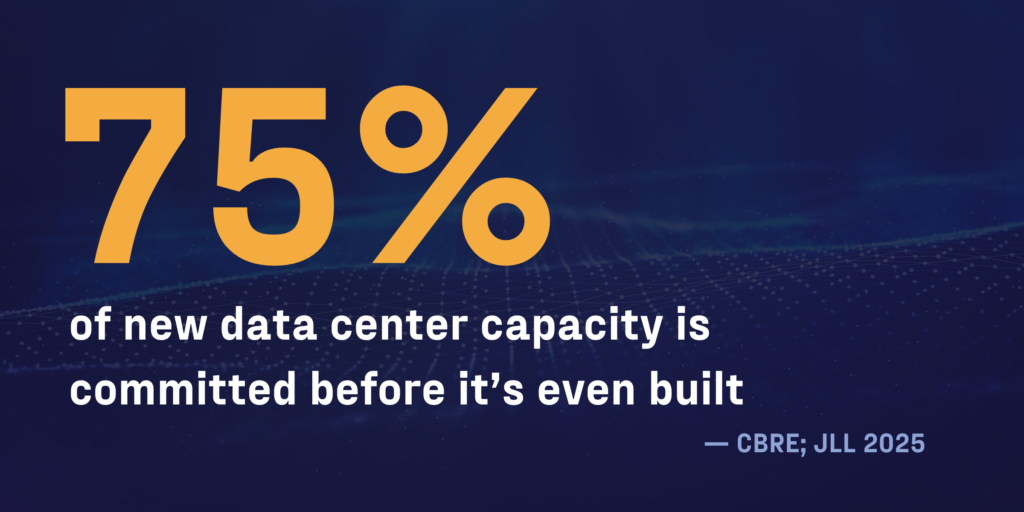
When space is tight and future capacity is already spoken for, there’s no slack in the system. Delays don’t disappear. They extend build timelines and slow delivery. In that environment, workforce readiness directly affects how fast capacity goes live.
This is no longer just a hiring challenge. It’s becoming an operational constraint.
The strain is showing up on job sites
The race to add capacity has made data center construction one of the most labor-intensive segments of commercial development. That pressure is now visible in project data.
More than half of equipment manufacturers, engineers, and construction firms report that staffing shortages have already disrupted job sites (Uptime Institute survey cited in Wall Street Journal, 2025). Contractors working on data centers are carrying backlogs that average nearly 11 months.
The risk compounds in operations
The staffing challenge does not ease once facilities go live. It shifts into day-to-day operations.
Nearly two-thirds of operators report difficulty retaining staff, finding qualified candidates, or both (Uptime Institute, 2025). Junior-level facilities employees remain in the shortest supply and experience the highest turnover (Uptime Intelligence, 2025). These are the frontline roles responsible for monitoring systems, following procedures, and keeping facilities running reliably.
As AI-driven facilities grow more complex, the consequences of staffing gaps increase. When frontline roles turn over frequently, process consistency weakens and supervisors stretch thinner. In environments where uptime matters, those gaps raise operational risk.

Outages expose the cost
The operational impact of workforce gaps is not theoretical.
Half of operators report that the data center they work in has experienced an outage in the past three years (Uptime Institute, 2025). Even more telling, 87% of organizations that experienced a major outage believe it could have been prevented with better management or operational processes.
Incident-related outages frequently cost between $100,000 and over $1 million when direct losses, opportunity costs, and reputational impact are factored in (Uptime Institute, 2025). Even one preventable outage carries meaningful financial and reputational consequences.
Staffing shortages do not automatically cause outages. But when retention is unstable and process gaps persist, the likelihood of preventable incidents increases.
Hiring is moving talent around. Not growing it.
With the rising outages and operational strain, many operators are responding the only way they can: by spending more and hiring faster.
More than half report higher salary-related costs, and a third report increasing new hires this year (Uptime Institute, 2025). Yet staffing shortages continue to rank among the industry’s top operational challenges.
If hiring were expanding the workforce, those shortages would be easing.
Instead, competition for experienced technicians is intensifying. Junior and mid-level operations roles, the most in-demand positions, show the highest turnover rates (Uptime Institute, 2025). Technicians move from one employer to another, often for higher pay, but the overall supply of qualified talent does not materially increase.
This is not a recruiting problem. It is a supply problem.
Hiring faster and paying more can redistribute existing talent. They cannot create the next generation of technicians at scale.

Per Scholas is changing the math
If the constraint is supply, the solution has to increase it.
Since 2022, Per Scholas has partnered with industry leaders to design data center training programs aligned to real-world hiring needs. More than 200 professionals have entered data center career pathways through these programs. In 2025 alone, 237 learners completed immersive training across multiple markets, with a 92 percent graduation rate.
Hiring alone reshuffles a finite talent pool. Expanding it changes what is possible.
Partner with Per Scholas to expand your data center talent pipeline.
We train safety-first, job-ready technicians in low-voltage cabling, hardware installation, power and cooling fundamentals, and enterprise IT operations — the skills required inside live data center environments.
With Per Scholas as your partner, you can hire talent who can contribute from day one, or reskill your existing workforce into data center and infrastructure roles through employer-aligned training built around how your facilities actually run.